


As we have come to the semiquincentennial celebration of the United States, I have decided to highlight scenes from early American history that provide a spiritual window into our nation’s founding. This series will begin in 1774 in Virginia’s capital city of Williamsburg with a controversial resolution that called for prayer and fasting in response to Britain’s measures against Boston. This resolution and the subsequent clash over this day of prayer and fasting are important links in the chain of events moving toward the American Revolution, and it ultimately led to the assembly of the First Continental Congress that fall.
As the apostle Paul exhorted Timothy to pray in 1 Timothy 2:1-2, it is right and essential for Christians to pray for the nations we inhabit, for “all people, for kings and all who are in high positions, that we may lead a peaceful and quiet life, godly and dignified in every way.” It is my hope that this series will encourage you in your prayers for our nation in 2026.
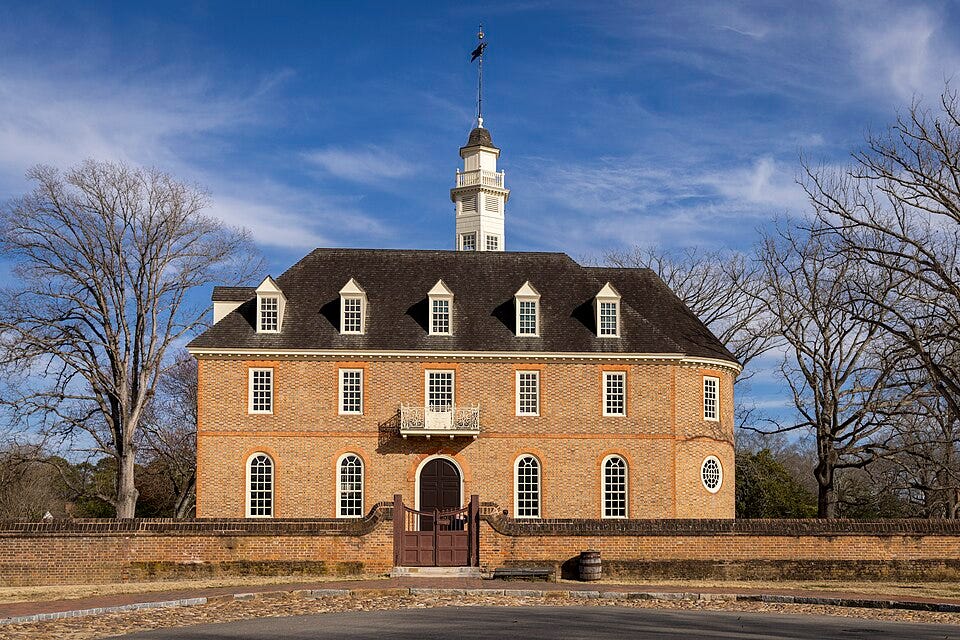
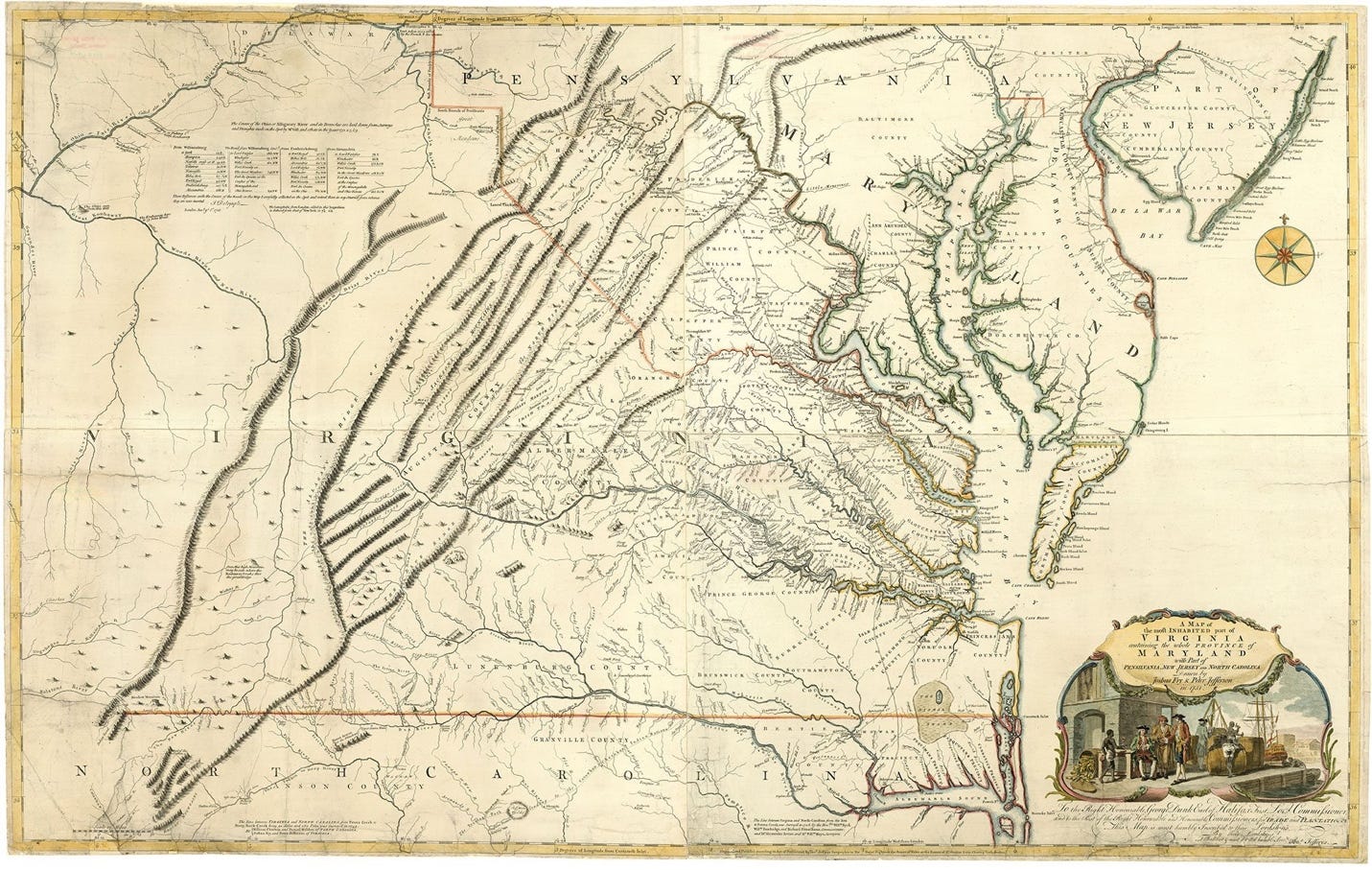
Williamsburg served as the capital of Virginia from 1699–1780. At the time, Virginia was not only by far the largest colony in British America with an estimated 447,016 people in 1770, but Virginia was the largest geographically.[1] Though it had defined northern and southern boundaries, the western boundary was not finalized, and claims extended out to the Mississippi River.[2] French encroachment on those claims had previously led to the French and Indian War. Virginia’s size along with the events of 1774 help to explain Virginia’s prominence and leadership among the colonies during that period.
The colonial government at this time was led by the royal governor Lord Dunmore, and two legislative houses. The House of Burgesses was the lower house, being made up of Burgesses elected from every county, whereas the upper house consisted of unelected members of the Governor’s Council who were royal appointees from among Virginia’s wealthiest and most powerful families. This structure mirrored the House of Lords and the House of Commons in Parliament.
In May of 1774, news of Parliament’s Boston Port Act arrived from London, announcing that a naval blockade of Boston was scheduled to begin on June 1, 1774. This punitive act by Parliament laid consequences upon the entire colony of Massachusetts Bay in response to Samuel Adams’ Sons of Liberty who had boarded ships at Griffin’s Wharf and dumped 342 chests of tea into the harbor in December 1773. Though the Boston Tea Party served as one of the catalysts for the American Revolution, it was but one event in a series of escalations as new taxes were levied, goods were boycotted, custom fees were avoided by smuggling, and governance became increasingly severe. A blockade of its primary port city would be devastating to Boston’s economy and the livelihoods of those who lived in Massachusetts Bay. This decision by Parliament was condemned as an unjust seizure of the wharves and docks of Boston, amounting to theft, a violation of the eighth commandment in Exodus 20:15. The Boston Port Act was understood as a threat to Boston’s civil liberties as collective punishment would be dealt out to the entire colony instead of being limited to those guilty of destroying the tea. The blockade would be economically devastating as it destroyed the livelihoods of many and even threatened starvation.
Drafting the Resolution (Monday, May 23, 1774)
As news of the Boston Port Act arrived, Thomas Jefferson, Patrick Henry, Richard Henry Lee, Francis Lightfoot Lee, and a handful of other Burgesses met on Monday, May 23, 1774 to consider a response. They were appalled by the naval blockade and agreed that Virginia must stand with Massachusetts. Toward that end, they decided that it was appropriate to call for a day of prayer and fasting for the city of Boston in order to awaken Virginians to the severity of the crisis.
Jefferson noted that it had been about twenty years since a day of prayer and fasting had been held in Virginia, the last going back to “the days of our distresses in the war of 55,” which followed General Braddock’s disastrous defeat at the Battle of the Monongahela on July 9, 1755.[3] The French and Indian War (1754-1763) had a significant religious dimension as French aggression was quickly seen as a Roman Catholic threat to Protestant civil and religious liberties. Following Braddock’s defeat, the Virginia House of Burgesses declared the priority of defending the colony for the sake of preserving “that which is so valuable and dear to them––their civil and religious liberties.”[4] There was real alarm as there was no religious tolerance in Catholic France and the persecution was brutal. Across the Atlantic, Protestant pastors were executed, children were seized and placed in Catholic homes, women who refused to convert were sentenced to life imprisonment, and men were enslaved in galleys. In one 1755 sermon to Virginia Volunteers, Samuel Davies proclaimed, “Our Territories are invaded by the Power and Perfidy of France; our Frontiers ravaged by merciless Savages, and our Fellow-Subjects there murdered with all the horrid Arts of Indian and Popish torture.”[5]
As the Boston Port Act threatened civil liberties in British America, it was time to be alarmed, and it was time to call the colony to prayer. In considering the language for the resolution, Jefferson described their efforts and how they looked for historical precedent in the record of the Puritans as documented by John Rushworth:
“The lead in the house on these subjects being no longer left to the old members, Mr. Henry, R. H. Lee, Fr. L. Lee, 3. or 4. other members, whom I do not recollect, and myself, agreeing that we must boldly take an unequivocal stand in the line with Massachusetts, determined to meet and consult on the proper measures in the council chamber, for the benefit of the library in that room. We were under conviction of the necessity of arousing our people from the lethargy into which they had fallen as to passing events; and thought that the appointment of a day of general fasting and prayer would be most likely to call up and alarm their attention. No example of such a solemnity had existed since the days of our distresses in the war of 55. since which a new generation had grown up. With the help therefore of Rushworth, whom we rummaged over for the revolutionary precedents and forms of the Puritans of that day, preserved by him, we cooked up a resolution, somewhat modernizing their phrases, for appointing the 1st day of June, on which the Port bill was to commence, for a day of fasting, humiliation and prayer, to implore heaven to avert from us the evils of civil war, to inspire us with firmness in support of our rights, and to turn the hearts of the King and parliament to moderation and justice.”[6]
The works consulted by the Burgesses in the upper house chamber were John Rushworth’s Historical Collections of Private Passages of State, being an eight-volume compilation of documents from 1618-48. You can access and review Rushworth’s volumes here.[7] While Jefferson did not relay which passages in Rushworth were adapted as the basis for the resolution, the following are likely examples:
On January 30, 1628, both houses of Parliament petitioned Charles I to proclaim a day of fasting and prayer to seek God’s blessing and protection on their nation, and to pray for churches outside England that were being persecuted by Catholicism. Charles I approved the request.[8]
On November 7, 1640, both houses of Parliament called for “one Day’s Solemn Humiliation in Fasting and Prayer” to seek God’s blessing, help, and direction for the safety and welfare of the king and the nation. Charles I approved the request.[9]
Using these precedents, Jefferson, Henry, and the others drafted the following resolution:
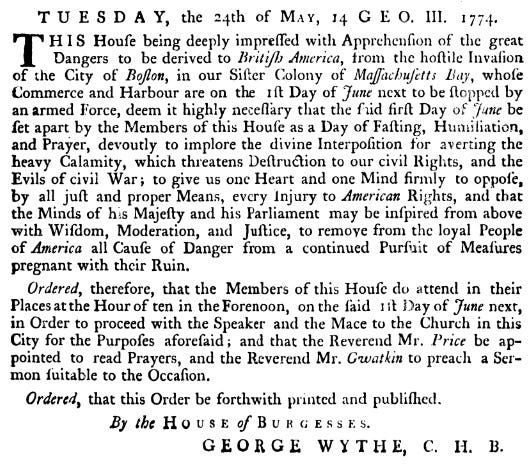
This House being deeply impressed with Apprehension of the great Dangers to be derived to British America, from the hostile Invasion of the City of Boston, in our Sister Colony of Massachusetts Bay, whose Commerce and Harbour are on the 1st Day of June next to be stopped by an armed Force, deem it highly necessary that the said first Day of June be set apart by the Members of this House as a Day of Fasting, Humiliation, and Prayer, devoutly to implore the divine Interposition for averting the heavy Calamity, which threatens Destruction to our civil Rights, and the Evils of civil War; to give us one Heart and one Mind firmly to oppose, by all just and proper Means, every Injury to American Rights, and that the Minds of his Majesty and his Parliament may be inspired from above with Wisdom, Moderation, and Justice, to remove from the loyal People of America all Cause of Danger from a continued Pursuit of Measures pregnant with their Ruin.[10]
Jefferson and the two Lees would all go on to serve as delegates in the Continental Congress and become signers of the Declaration of Independence. They were not revolutionaries from the beginning, but as evidenced in this resolution, it was their prayer that God would remove the threat of civil war, protect American rights, and restore the relationship between Britain and British America.
Presenting the Resolution (Tuesday, May 24, 1774)
Now that the resolution was written, the next step was to decide who would present it to the House of Burgesses. In thinking about this, the drafters concluded they should ask Robert Carter Nicholas, who also served as the Treasurer of Virginia, to present the resolution:
To give greater emphasis to our proposition, we agreed to wait the next morning on Mr. Nicholas, whose grave and religious character was more in unison with the tone of our resolution and to solicit him to move it. We accordingly went to him in the morning.[11]
Nicholas was a good choice for presenting the resolution as he was a critically important figure in the Virginia government and he brought an unquestionable gravitas. In addition to serving as Burgess, he served as the Treasurer of the Colony and was well known for resolving a major financial scandal from the previous treasurer. Speaker Peyton Randolph had also appointed him to serve as the chair of the Committee for Religion, which would address matters related to the governing of the Anglican Church in Virginia as there was no American bishop.[12]
Nicholas had a reputation as a serious Christian and faithful churchman who cared deeply about preserving theological orthodoxy. He served on the vestry at Bruton Parish Church in Williamsburg, where he had been embroiled in public religious conflict for the past few years. He opposed Samuel Henley’s applications on more than one occasion to prevent him from serving as rector of Bruton Parish. Henley was a professor at William and Mary who applied to fill vacancies in 1772 and again in 1773. Brent Tarter’s biography of Nicholas describes this controversy in detail which played out publicly on the pages of the Virginia Gazette, including testimony given by Nicholas’ wife Anne, Richard Bland, and John Page. They testified that Henley denied the deity of Christ, the doctrine of the Trinity, and the existence of Satan and hell. Page testified that Henley was a Socinian, that is, one who denies the doctrine of the Trinity.[13] Contemporaries who opposed Socinianism across the Atlantic include both John Gill and John Newton. In the end, Nicholas prevailed, and Henley was prevented from serving at Bruton Parish Church, though he retained his post at William and Mary until he fled to England in 1775.
After meeting with the authors of the resolution, Robert Carter Nicholas agreed to move it, and he would do so that very day. Nicholas, Jefferson, Henry, and the others joined the Burgesses in the legislative chamber in the Williamsburg Capitol.
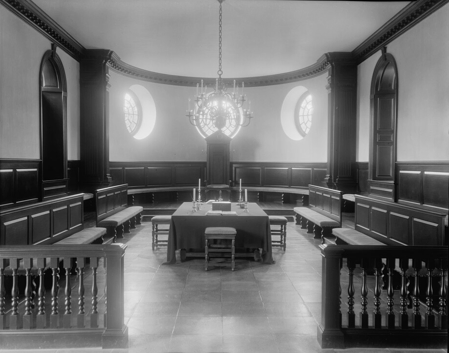
Nicholas presented the resolution, and it passed. With slight variance from Jefferson’s recollection that “it passed without opposition,”[14] Nicholas noted that there were two who opposed, and only one member who spoke against it. The silent opponent was Attorney General John Randolph, the brother to Peyton Randolph, the Speaker of the House. He would later respond with an anonymously written condemnation in which he would mock the day of prayer and fasting. In the days that followed, Nicholas likewise would write a rebuttal and rebuke Randolph.[15]
As the resolution motion was finalized, the House of Burgesses established details for the day of prayer and fasting. It would be held on June 1, 1774 and Peyton Randolph, the Speaker of the House, would lead them in procession to Bruton Parish Church for the service:
Ordered, therefore, that the Members of this House do attend in their Places at the Hour of ten in the Forenoon, on the said 1st Day of June next, in Order to proceed with the Speaker and the Mace to the Church in this City for the Purposes aforesaid; and that the Reverend Mr. Price be appointed to read Prayers, and the Reverend Mr. Gwatkin to preach a Sermon suitable to the Occasion.
Lord Dunmore’s Dissolution of the House of Burgesses (Thursday, May 26, 1774)
After the resolution was passed, the House of Burgesses had it printed by the Virginia Gazette on Thursday, May 26, 1774 and it was distributed throughout the city.
Thomas Gwatkin of Bruton Parish Church had not agreed to the request personally and promptly bowed out of it. The Gazette reported that “Upon the Reverend Gwatkin’s petitioning to be excluded from complying with his Appointment, the Reverend Mr. Price, Chaplain to the House, was directed to preach in his Stead.”[16] Thomas Price’s role was expanded from leading in prayers to also preaching the sermon.
Though the resolution had near unanimous support from Virginia’s government, such support was not shared by John Murray, the Fourth Earl of Dunmore. Serving as governor was a royal appointment, and Lord Dunmore’s loyalties to King George were strong. He summoned the Governor’s Council and related his intention to dissolve the Burgesses. They responded to Dunmore with silence. Disadvantages stood with either position. Affirming Dunmore would be unpopular among the citizens of Virginia, and opposing Dunmore could jeopardize their seats on the council.
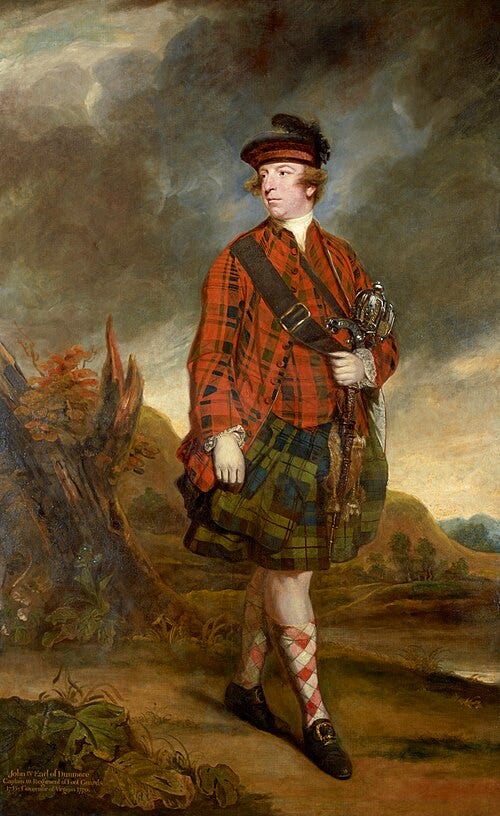
Dunmore summoned the Burgesses to the upper council chamber. Adding 103 Burgesses to this room was not realistic, but it was a power move.
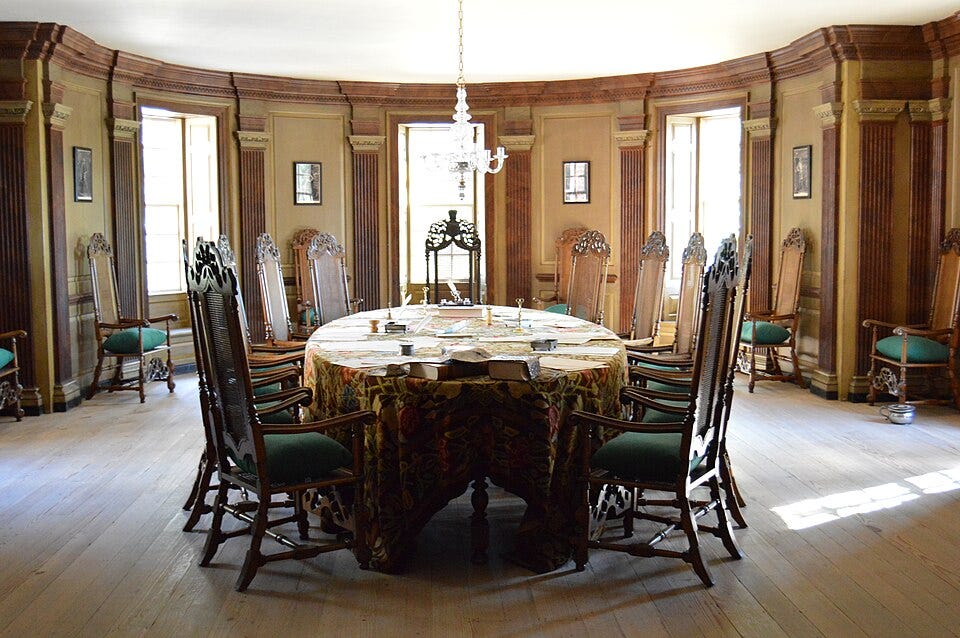
The Gazette reported on the meeting:
“Yesterday, between three and four o’Clock P.M. the Right Honourable the Earl of Dunmore sent a Message to the Honourable the House of Burgesses by the Clerk of the Council, requiring their immediate Attendance in the Council Chamber, when his Excellency spoke to them as follows: Mr. Speaker, and Gentlemen of the House of Burgesses, I have in my hand a paper, published by order of your House, conceived in such terms as reflect highly upon his Majesty and the Parliament of Great Britain; which makes it necessary for me to dissolve you, and you are dissolved accordingly.”[17]
This event is but one of many where royal authority was used to dissolve representative houses in the colonies, resulting in “official” local rule by royal appointees instead of elected representatives. This became one of the many grievances against the king in the Declaration of Independence: “He has dissolved Representative Houses repeatedly, for opposing with manly firmness his invasions on the rights of the people.”[18]
Though the House of Burgesses was dissolved, the former members continued to hold the day of prayer and fasting on June 1 with prayers for Massachusetts. Before that happened, they would gather in Raleigh Tavern and set in motion events which would lead to the Continental Congress. Before leaving Williamsburg they would also ironically host a previously scheduled ball to welcome Lady Dunmore to the city. This day of prayer and fasting and the drama surrounding it is an essential link in the chain of events leading to the American Revolution. I plan to examine this further in another post.
Let us Give Ourselves to Repentance and Prayer
As the Day of Prayer and Fasting was opposed by Dunmore and mocked by John Randolph, Robert Carter Nicholas wrote a defense for the day. Instead of it being the mere skipping of a meal as caricatured by Randolph, it was a true call to humble repentance before the Lord.
“We should be extremely careful to examine our hearts; to endeavor at a reformation of whatever may be found amiss; to repent heartily of all our sins and to prepare our minds for the reception of the influences of his good Spirit. Can any means be better adapted to this end, than withdrawing our attention for a season, from the business and cares of the world, and mortifying all our corrupt affections by fasting and prayer?”[19]
Prayer and repentance were coupled together, for repentance was essential for one’s prayers to be heard, as the psalmist wrote, “If I had cherished iniquity in my heart, the Lord would not have listened. But truly God has listened; he has attended to the voice of my prayer. Blessed be God, because he has not rejected my prayer or removed his steadfast love from me!” (Psalm 66:18–20). If there was to be a day of prayer, such intercession should be preceded by repentance.
We can observe significant discontinuity today as contemporary calls to prayer are often uncoupled from repentance. We have become a spiritually divided nation. Prayers in response to tragedy are often treated with contempt by those who seek to use such crises as a means of advancing political agendas. Expressions of prayer are easily assumed to be disingenuous and rejected as mere platitudes. While charade deserves rebuke, it is an indictment upon our nation when there is scorn for prayerful intercession because salvation is believed to be found in one’s policy proposals instead of in the Lord. America needs to awaken to the severity of the spiritual crisis of our own day. Let us humble ourselves and pray that God would mercifully intervene and bring our nation to true repentance and faith in our Savior Jesus Christ.
[1] Estimated population of colonial Virginia in 1770. U.S. Bureau of the Census, Historical Statistics of the United States, Colonial Times to 1970, bicentennial ed. (Washington, DC: Government Printing Office, 1975).
[2] Virginia’s 1609 charter claims extended to the Mississippi River. See the Second Charter of Virginia (23 May 1609), Avalon Project, Yale Law School, https://avalon.law.yale.edu/17th_century/va02.asp.
[3] Thomas Jefferson, Autobiography, in Paul Leicester Ford, ed., The Works of Thomas Jefferson, Federal Edition, vol. 1 (New York: G. P. Putnam’s Sons, 1904), 11–12.
[4] Address of the House of Burgesses to Governor Robert Dinwiddie, in H. R. McIlwaine, ed., Journals of the House of Burgesses of Virginia, 1752–1755, 1756–1758 (Richmond: Virginia State Library, 1909).
[5] Samuel Davies, Religion and Patriotism the Constituents of a Good Soldier: A Sermon Preached to Captain Overton’s Independent Company of Volunteers, Raised in Hanover County, Virginia, August 17, 1755 (Philadelphia: James Chattin, 1755), 3.
[6] Jefferson, Autobiography, in Ford, Works of Thomas Jefferson, 1:11–12.
[7] John Rushworth, Historical Collections of Private Passages of State, 8 vols. (London, 1659–1701), available at British History Online, https://www.british-history.ac.uk/series/rushworth-private-passages-state.
[8] Rushworth, Historical Collections, vol. 1, https://www.british-history.ac.uk/rushworth-papers/vol1/pp650-662.
[9] Rushworth, Historical Collections, vol. 4, https://www.british-history.ac.uk/rushworth-papers/vol4/pp1-45.
[10] Purdie and Dixon’s Virginia Gazette (Williamsburg), 26 May 1774.
[11] Jefferson, Autobiography, in Ford, Works of Thomas Jefferson, 1:12.
[12] Paul K. Longmore, “‘All Matters and Things Relating to Religion and Morality,’ The Virginia Burgesses’ Committee for Religion, 1769 to 1775,” Journal of Church and State 38, no. 4 (Autumn 1996): 775–97, at 778–80.
[13]Brent Tarter, Virginia’s Forgotten Founder: The World of Robert Carter Nicholas (Charlottesville: University of Virginia Press, 2026), 132–33.
[14] Jefferson, Autobiography, in Ford, Works of Thomas Jefferson, 1:12.
[15] Robert L. Scribner, ed., Revolutionary Virginia: The Road to Independence, vol. 1, Forming Thunderclouds and the First Convention, 1763–1774 (Charlottesville: University Press of Virginia, 1973), 94. See the same volume for the pamphlet exchange between John Randolph and Robert Carter Nicholas.
[16] Purdie and Dixon’s Virginia Gazette (Williamsburg), 26 May 1774.
[17] Purdie and Dixon’s Virginia Gazette (Williamsburg), 26 May 1774..
[18] Declaration of Independence (4 July 1776)
[19] Robert Carter Nicholas, Considerations on the Present State of Virginia Examined ([Williamsburg], 1774), answering John Randolph, Considerations on the Present State of Virginia (1774).