


This is the second post in a series on the intersection of early American church history and our nation’s founding. In the first post I reviewed the Virginia House of Burgesses’ resolution that called for a day of prayer and fasting on June 1, 1774, and Lord Dunmore’s punitive reaction to dissolve the assembly. This second post will follow the events in Williamsburg after the dissolution of the House of Burgesses and the day of prayer and fasting on June 1.
When Lord Dunmore dissolved the House of Burgesses on May 26, 1774, the late members remained in Williamsburg to continue the work before them. They would respond to the Boston Port Act, host a previously scheduled ball in Lady Dunmore’s honor, and attend the day of prayer and fasting at Bruton Parish Church.
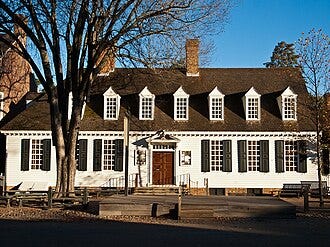
The Raleigh Tavern Association (Friday Morning, May 27, 1774)
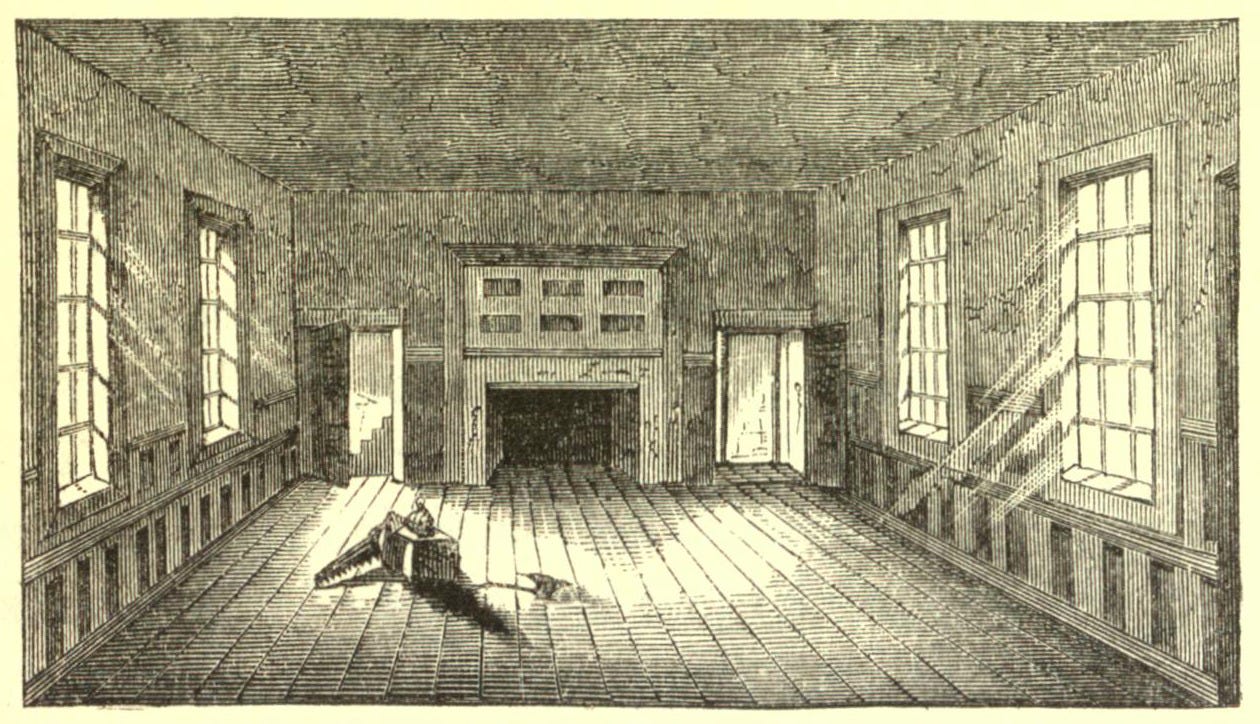
The morning after their dissolution they assembled at Raleigh Tavern where they met in the Apollo Room and the day’s deliberations concluded with the signing of a document that became known as the Association. This document opposed the Boston Port Act, rejected taxation without representation, and suspended commerce with Britain to apply economic pressure for the redress of grievances. It also called for the organization of a congress of representatives from the thirteen colonies of British America, the efforts of which would bring together the First Continental Congress in Philadelphia that fall. Though not legally binding in the eyes of the British crown, it informally bound the late Burgesses together.
The Virginia Gazette reported:
“This day, at ten o’Clock, the Honourable Members of the late House of Burgesses met, by Agreement, at the long Room in the Raleigh Tavern in this City, called the Apollo, when the following agreement was unanimously entered into by that patriotick assembly, in support of the constitutional liberties of America, against the late oppressive Act of the British Parliament respecting the town of Boston, which, in the end, must affect all the other colonies.”[1]
The Gazette published a broadsheet of the Association which you can read below:
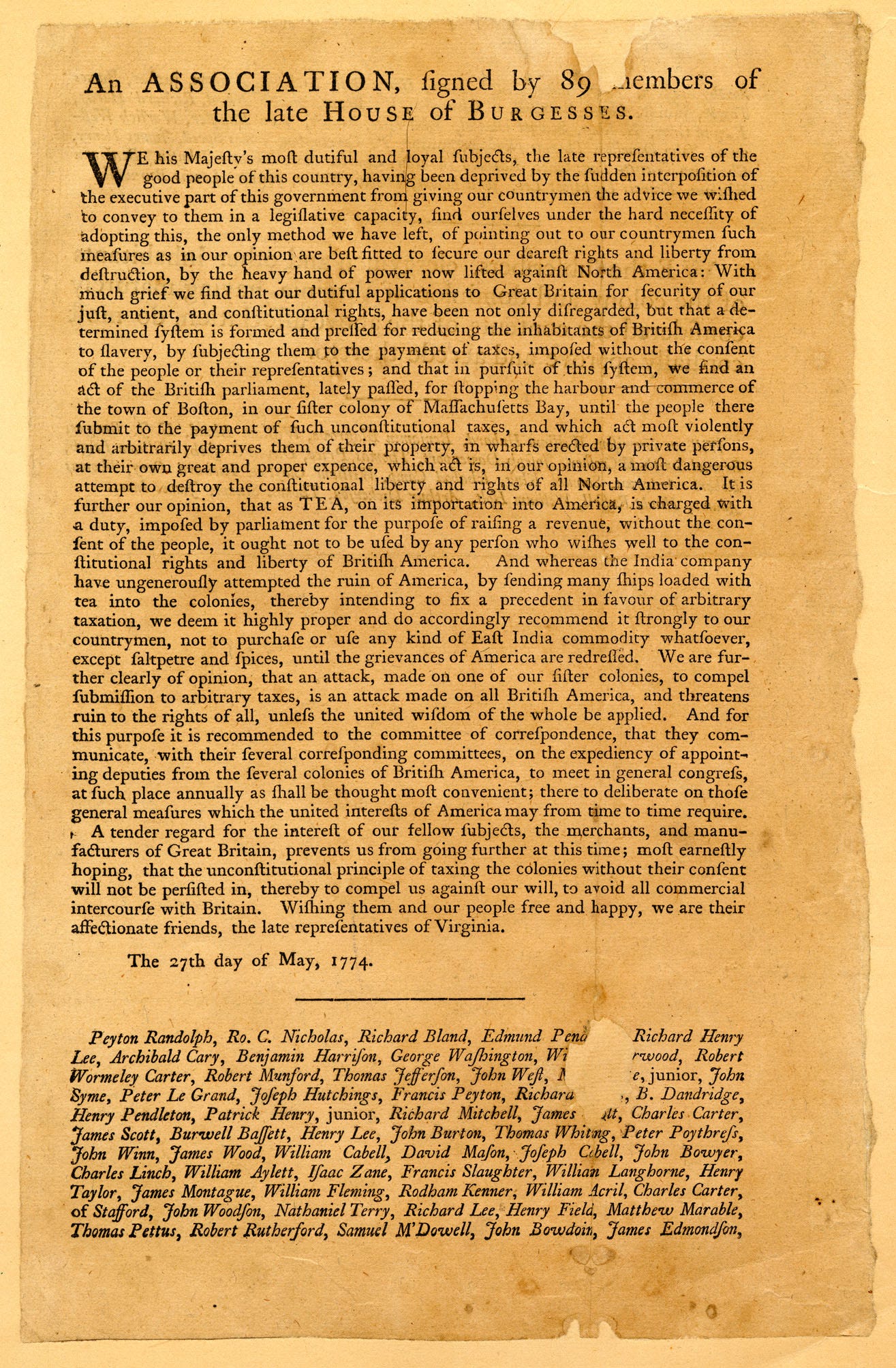
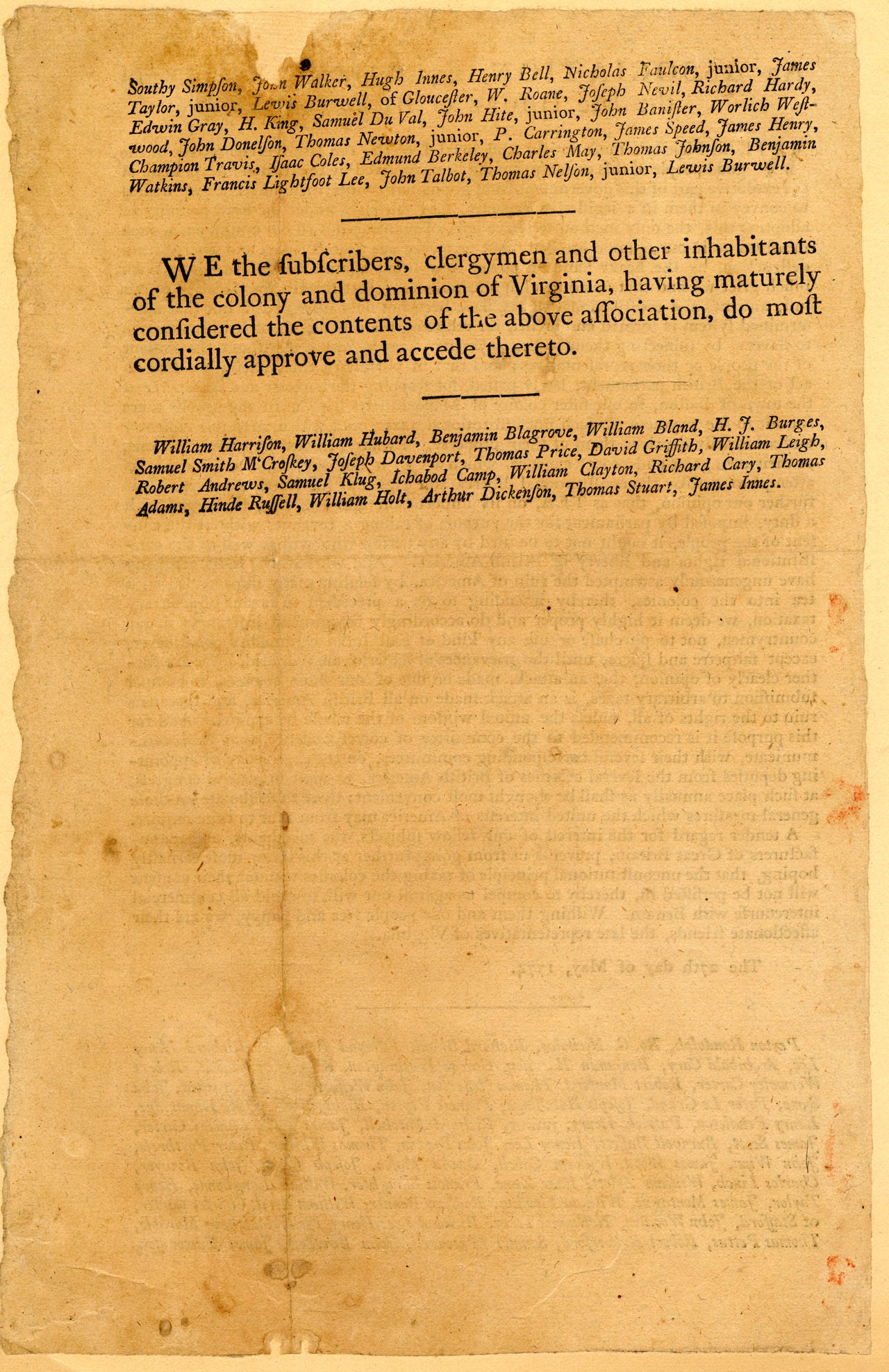
This effort was not confined to the late members of the House of Burgesses as many others were present at Raleigh Tavern and twenty-one citizens added their signatures.
The Gazette reported:
The above was immediately signed by the Honourable the Speaker and all the Members of the late House of Burgesses, as well as by a Number of Clergymen and other Inhabitants of the Colony, who, after having maturely considered the Contents of the Association, did most cordially approve and accede thereto.[2]
Signing tradition can be observed on the document as the first signature is Peyton Randolph, the speaker, immediately followed by Robert Carter Nicholas, the treasurer, who had previously presented the resolution for the day of prayer and fasting. The most famous of the signatures are of course George Washington, Thomas Jefferson, and Patrick Henry.
If you read the twenty-one additional signatures following the late members of the House of Burgesses, the majority of them were from Virginia’s pastors. This provides a sharp contrast with the allergy to political engagement that far too many pastors share today.
Thomas Price, the chaplain of the House of Burgesses, who was assigned to preach on the June 1 day of prayer and fasting signed the document. The application of economic pressure upon Britain in the defense of British America’s constitutional rights and liberties was a measure the clergy were eager to support.
The following clergy signed:
· Robert Andrews, who later served as a military chaplain during the Revolution.
· William Bland, who served in Bruton Parish in Williamsburg.
· Benjamin Blagrove, who served in Southwark Parish (Surry County) and other Tidewater parishes.
· Ichabod Camp, who served Amherst Parish (now Lexington Parish).
· Joseph Davenport, who served Charles Parish (York County).
· David Griffith, who served Shelburne Parish (Loudoun County).
· William Harrison who served in Dinwiddie and Prince George parishes.
· William Hubard, who served in Gloucester and Charlotte County parishes.
· Samuel Klug, served Christ Church in Middlesex County.
· William Leigh, who served in Chesterfield and Tidewater.
· Samuel Smith McCroskey, who served in Hungars Parish (Northampton County) on the Eastern Shore.
· Thomas Price, chaplain to the House of Burgesses.
In contrast to this, not all present in the Apollo Room at Raleigh Tavern signed the document. Eleven men were recorded as having abstained from signing, among whom are the following:[3]
· John Camm, President of William and Mary, and a member of the Governor’s Council. Camm also served as the commissary of Virginia, an office representing the bishop of London. He had previously advocated for the establishment of an Anglican Bishop in America, but that measure had been defeated by conservatives.
· Thomas Gwatkin, of Bruton Parish Church, who authored the sermon for the fast day, yet declined to preach it. Gwatkin also served on the faculty of William and Mary and as chaplain to Lord Dunmore’s family.
· Samuel Henley, a William and Mary professor who had been denied the pulpit at Bruton Parish Church by Robert Carter Nicholas.
· Devereux Jarratt, who served in Bath Parish in Dinwiddie County and participated in the revival movement of the Great Awakening.
· Seven others who remain unnamed.
For three who abstained, loyalties and past conflict are observable with Camm, Henley, and Gwatkin. This trio of faculty from William and Mary declined to support American rights as opposed to the dozen clergy who signed their names.
Jarratt and the May 1774 Virginia Clergy Conference
Devereux Jarratt abstained from signing the Association, but he would become a strong supporter of American independence. Jarratt is a largely forgotten figure in Virginian history, but he was a prominent figure in the Virginia revivals of 1775–1776.[4] In his biography, Jarratt described growing up within the Anglican church without the gospel. He was significantly influenced by reading sermons of George Whitefield and the works of the Puritan John Flavel. After his conversion he was seen as disruptive as he preached the necessity of being born again, and his willingness to fellowship with Methodists left him isolated by his Anglican peers. Ordination was impossible in the colonies as there was no bishop, so he traveled to Britain for education and ordination, and then returned to Virginia where he was placed at Bath Parish.
Jarratt described how he preached:
In a word, my plan was, first, To convince of sin. Second, of inability. Third, To point out the remedy and press the convicted to fly to Jesus Christ, and rest on him for complete salvation. And, fourth, to exhort those who believed, to be careful to maintain good works, and to go on to perfection.[5]
We learn from Jarratt’s biography that the Virginia clergy had been summoned to Williamsburg in May of 1774 for a conference by Camm, which explains their significant presence as a dozen joined the signing of the Association in Raleigh Tavern. Jarratt’s writing did not detail the focus of the conference, but he revealed the presence of theological liberalism and the poor fellowship that existed between him and the other clergy:
I have already mentioned the unkind disposition of the clergy towards me from the beginning. They always seemed to look at me with an evil eye, and therefore there was little or no intercourse between them and myself. However, in the year 1774, I went to one of their conventions, which they used to hold, in the city of Williamsburg, for certain purposes. At the convention, I was causelessly insulted, and treated in such an ungenteel, not to say unchristian, manner, as, till that time, I had been a stranger to––and, what was still worse, I was distressed to hear some of the most sacred doctrines of Christianity treated with ridicule and profane burlesque. You may be sure I went to no more of their conventions at Williamsburg.[6]
Lady Dunmore’s Ball (Friday Evening, May 27, 1774)
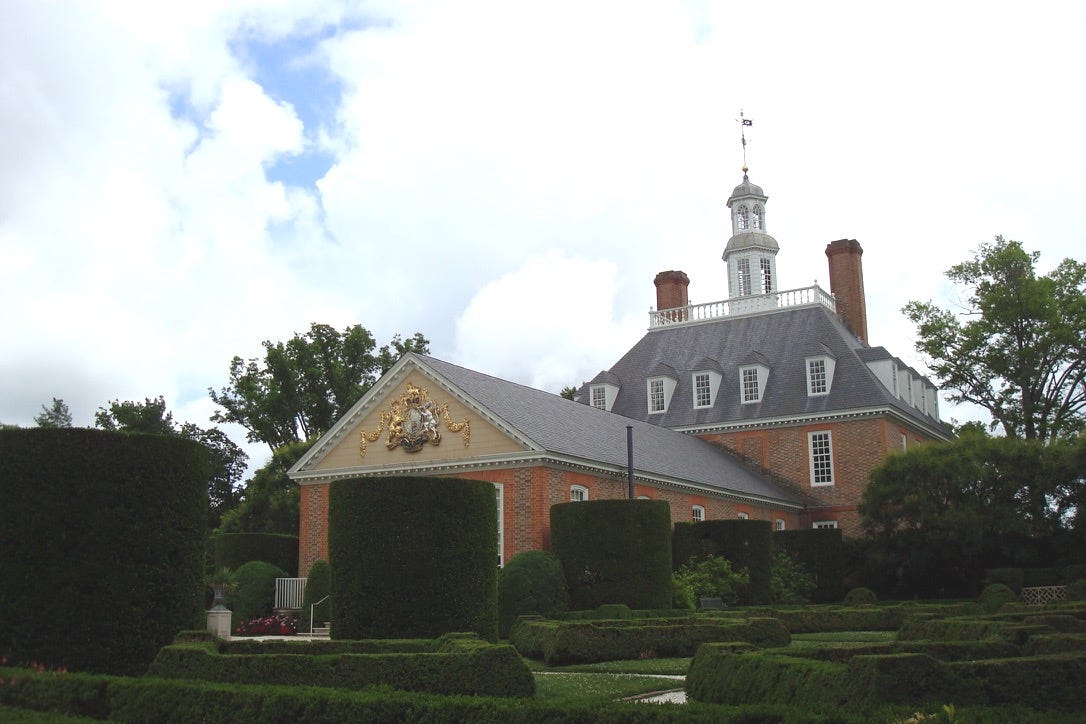
Following the signing of the Association at Raleigh Tavern, the Burgesses had a ball to attend. This event in honor of Lady Dunmore’s arrival to Virginia did not take place immediately upon her arrival, but it had been postponed until the Burgesses convened in Williamsburg. It would now ironically be held following their dissolution.
The Gazette announced that morning: “This evening there is to be a ball and entertainment at the Capitol, given by the honorable the House of Burgesses to welcome Lady Dunmore and the rest of our Governor’s family to Virginia.”[7]
Washington’s journal entry was understated for what one would expect to be a significantly awkward event: “Went to the Ball given by the House of Burgesses to Lady Dunmore.”[8]
A Convention Summons (Monday, May 30, 1774)
On Monday, May 30, 1774, twenty-five of the late Burgesses remained in Williamsburg while the rest returned to their homes across Virginia. With Peyton Randolph moderating, they met in Randolphs home, and then ended the day in Raleigh Tavern with the signing of a convention summons for the Burgesses. The document stated that “the Colony of Virginia will concur with the other Colonies in such Measures as shall be judged most effectual for the preservation of the Common Rights and Liberty of British America.”[9] Desiring to work in concert with the other colonies, they recalled the Burgesses to return to Williamsburg on August 1, 1774.
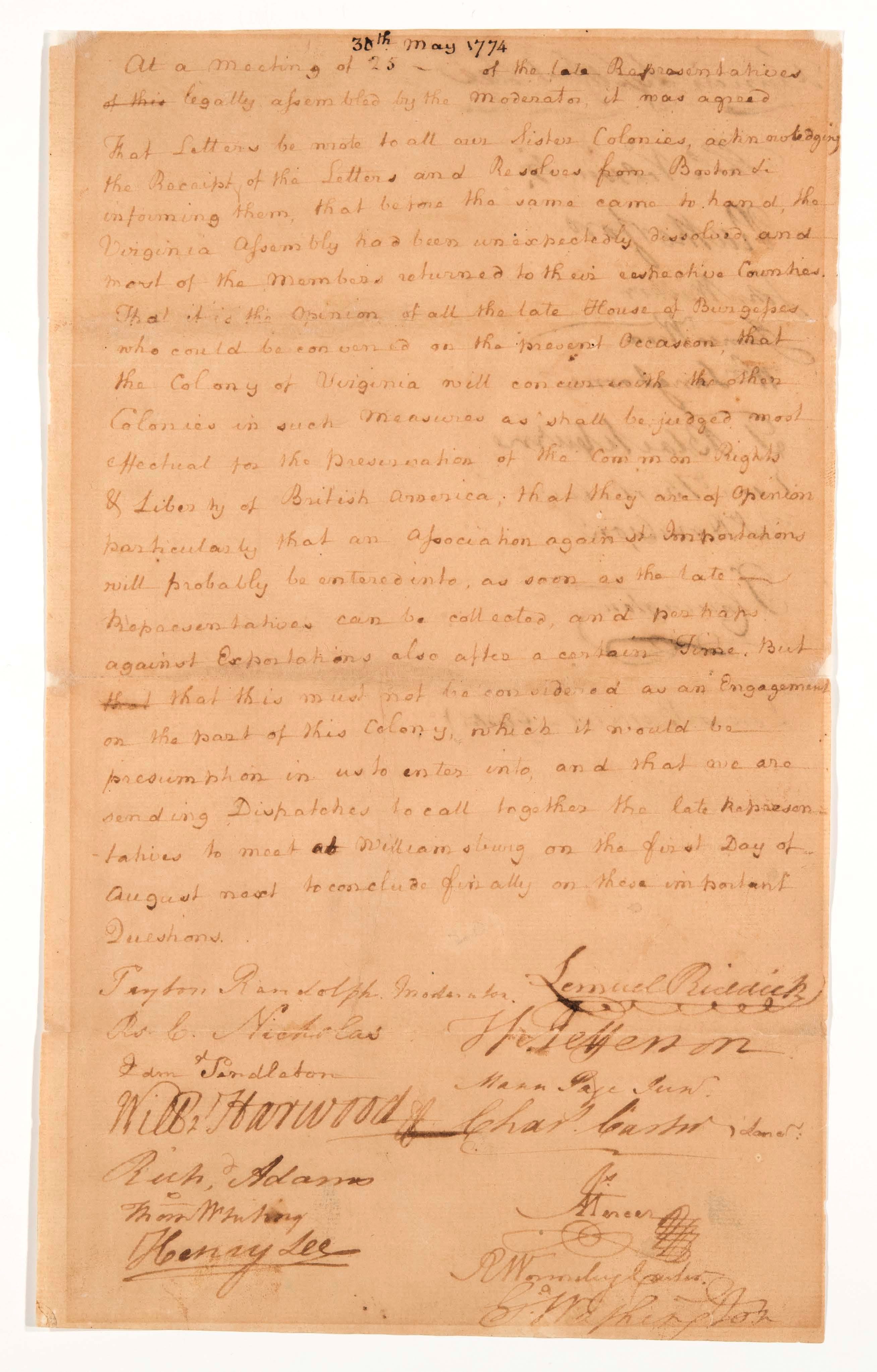
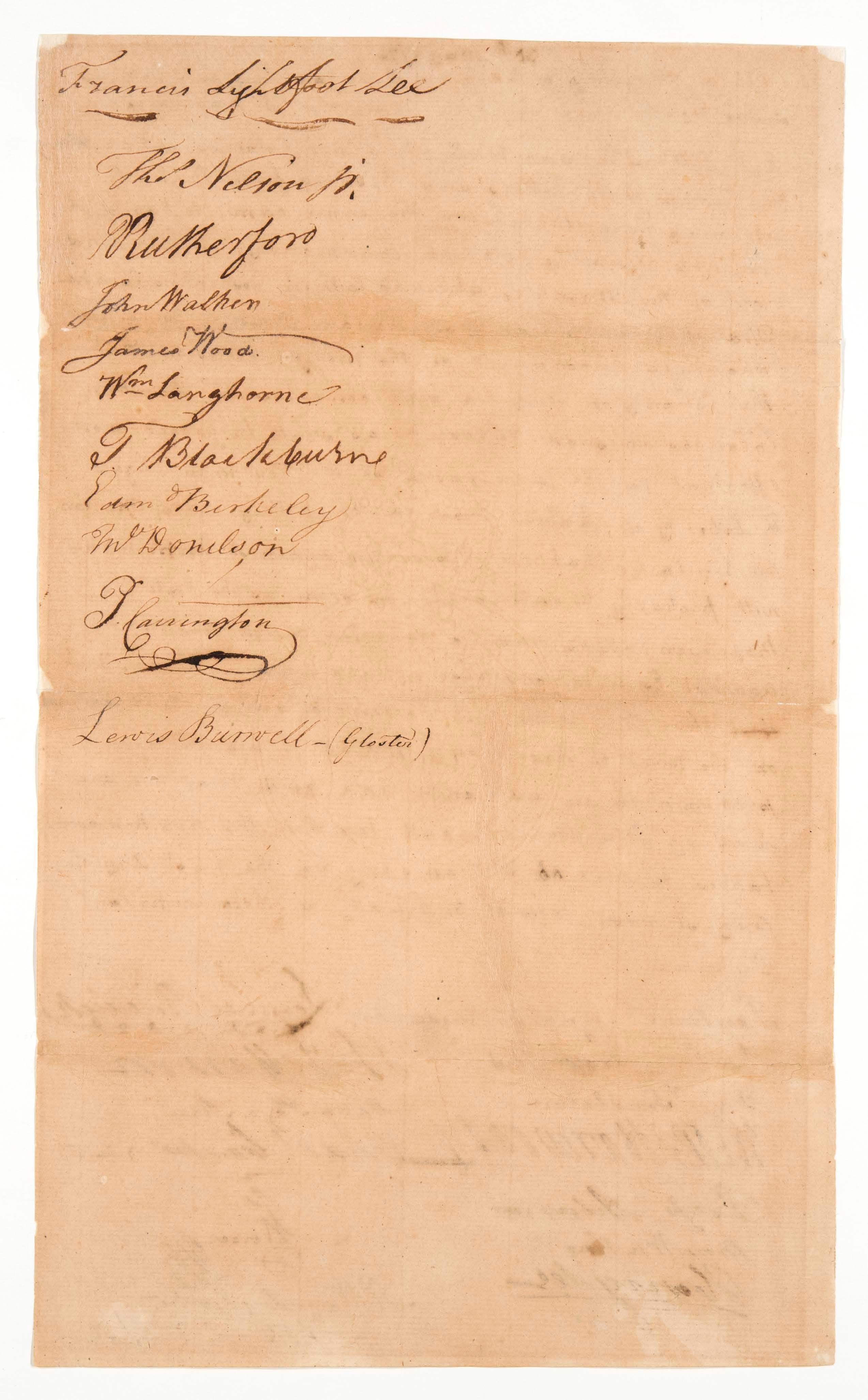
In a letter to William Fairfax, Washington sent a copy and described the meeting:
[T]he proceedings mentioned in the enclosed papers were had thereupon and a general meeting requested of all the late Representatives in this City on the first of August when it is hoped, and expected that some vigorous measures will be effectually adopted to obtain that justice which is denied to our Petitions and Remonstrances; in short the Ministry may rely on it that Americans will never be taxed without their own consent that the cause of Boston the despotic measures in respect to it I mean now is and ever will be considered as the cause of America (not that we approve their conduct in destroying the Tea) and that we shall not suffer ourselves to be sacrificed by piecemeal though God only knows what is to become of us.[10]
The Prince William County Statement (Tuesday, May 31, 1774)
In a parallel effort across Virginia, citizens in Dumfries met and called for county deliberations at the courthouse on Monday, June 6, 1774. This would be shared at the church on Wednesday, June 1, and also on Sunday, June 5.
At a Meeting of the inhabitance of the Town of Dumfries, in the County of Prince William, in the Colony of Virginia, on Tuesday, the thirty-first day of May, 1774 – RESOLVED, That it is the unanimous opinion of this meeting, that the Freeholders and others, inhabitance of this County, be invited to meet on Monday, the sixth day if June next, at the Court House of the said county to deliberate on measures the most proper to be taken to avert the dreadful calamities with which the Colonies in general, and the city of Boston in particular, are threatened from an unconstitutional act of Parliament lately passed, by which the town of Boston and its ports and harbours are to be blocked up by an armed force, which act, it is the opinion of this meeting, is fundamentally subsersive of out ancient, legal, and vital liberties, and that this resolve be published by the minister immediately after divine service on Wednesday, the first day and on Sunday, the fifth day of June next.
Resolved, that Messrs Cuthbert Bullitt, William Grayson, Foushee Tebbs, William Carr, Richard Graham, John Riddell, Cumberland Wilson, Andrew Leitch, and Do’r George Graham be a committee for this town, to correspond with the different committees of any colony or province within America. Resolved, That Evan Williams be appointed Clerk to this committee.[11]
The Prince William County effort did not yet include the Burgesses from Prince William County as Thomas Blackburn and Henry Lee had remained in Williamsburg and it took about three days to travel. The deliberations of June 6,1774 produced the Prince William County Resolves, the first statement of its kind from a Virginia county.
The Day of Prayer and Fasting (Wednesday, June 1, 1774)
On June 1, 1774, Washington’s journal reads with its usual brevity: “Went to church, fasted all day.”[12]
The morning of the appointed day of prayer and fasting had arrived, and the late Burgesses gathered at the courthouse along with a great crowd from Williamsburg and the surrounding countryside.
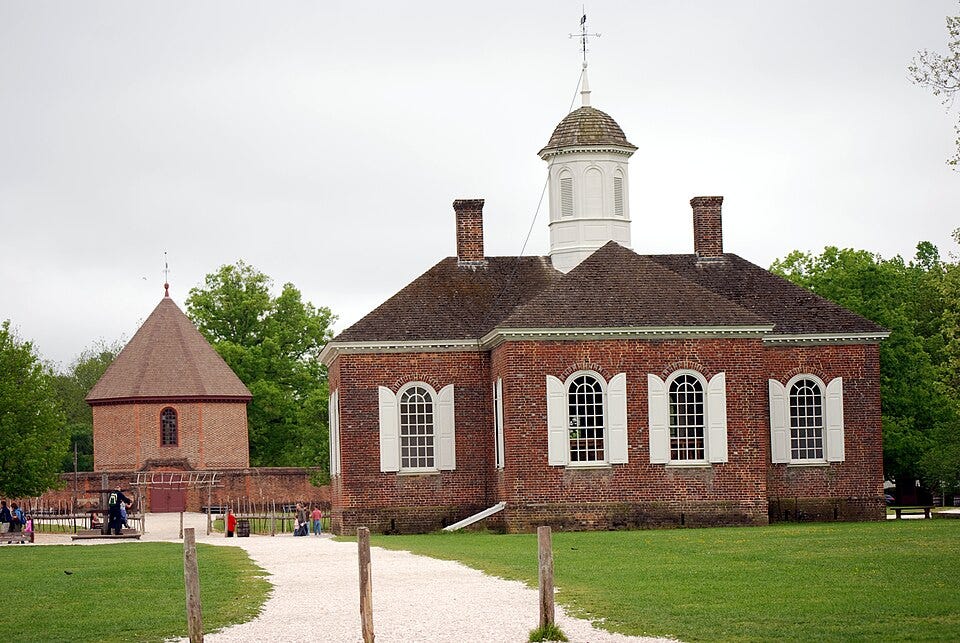
Peyton Randolph, the former Speaker of the House opened the day’s proceedings with a speech, after which he then carried the House of Burgesses’ ceremonial mace and led the crowd in a procession down the Duke of Gloucester Street to Bruton Parish Church for the worship service.
The Virginia Gazette reported:
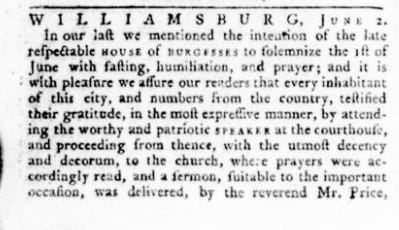
In our last we mentioned the intention of the late respectable House of Burgesses to solemnize the 1st of June with fasting, humiliation, and prayer; and it is with pleasure we assure our readers that every inhabitant of this city, and numbers from the country, testified their gratitude, in the most expressive manner, by attending the worthy and patriotic speaker at the courthouse, and proceeding from thence, with the utmost decency and decorum, to the church.[13]
The service was well attended, and the Gazette stressed the appreciation of the citizens for the day. The size of the crowd revealed that it was not an empty gesture, but that there was genuine concern among Virginians for the measures Britain was taking against Boston.
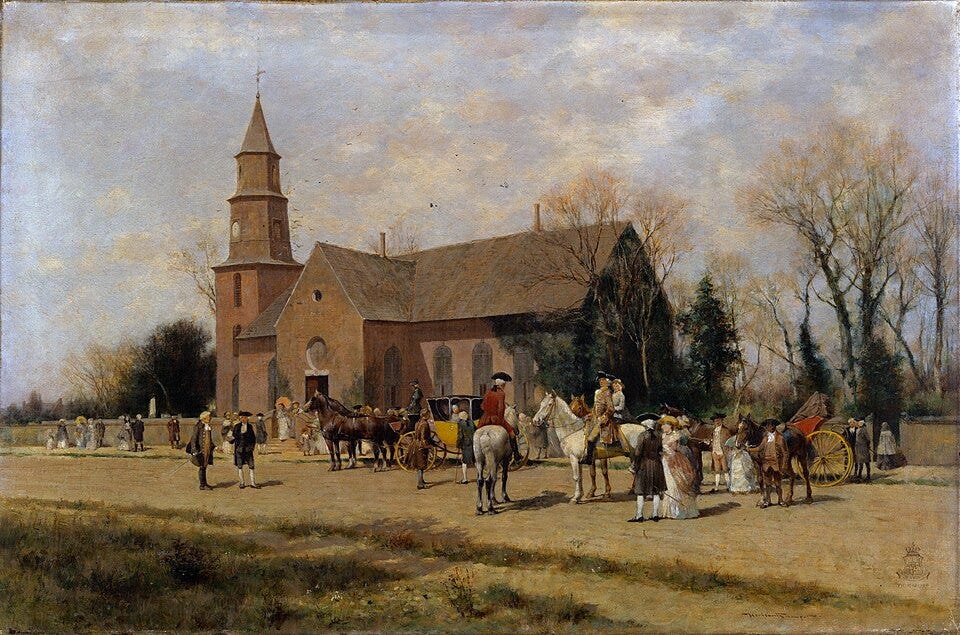
As the crowd entered the church, the day did not take the original shape the resolution had called for. Thomas Gwatkin had been unwilling to preach the sermon, and so it had been reassigned to Thomas Price.
In a letter from Lord Dunmore to Lord Dartmouth, Dunmore wrote that Gwatkin “civilly but with firmness declined being employed for such a purpose.”[14] Dunmore observed the day as an abuse of religion for a political stunt, and that Gwatkin would not lower himself to participate in such an occasion. The reality, however, is more complicated and it is doubtful whether Dunmore interpreted Gwatkin’s actions accurately. The Virginia Gazette reported that Thomas Price asked Thomas Gwatkin for assistance in preparing the sermon, and that Gwatkin assisted him by drafting the sermon that Price would preach on June 1.[15]
Thomas Price, the chaplain to the House of Burgesses, led the congregation in both prayer and in preaching the sermon for the fast day. His sermon was entitled The Doctrine of a Providence Considered, and he preached from Psalm 103:19.
The Virginia Gazette reported on the service:
“Prayers were accordingly read, and a sermon, suitable to the important occasion, was delivered, by the reverend Mr. Price, from the 103d psalm, and 19th, verse. The Lord hath prepared his seat in Heaven, and His kingdom ruleth over all.”[16]
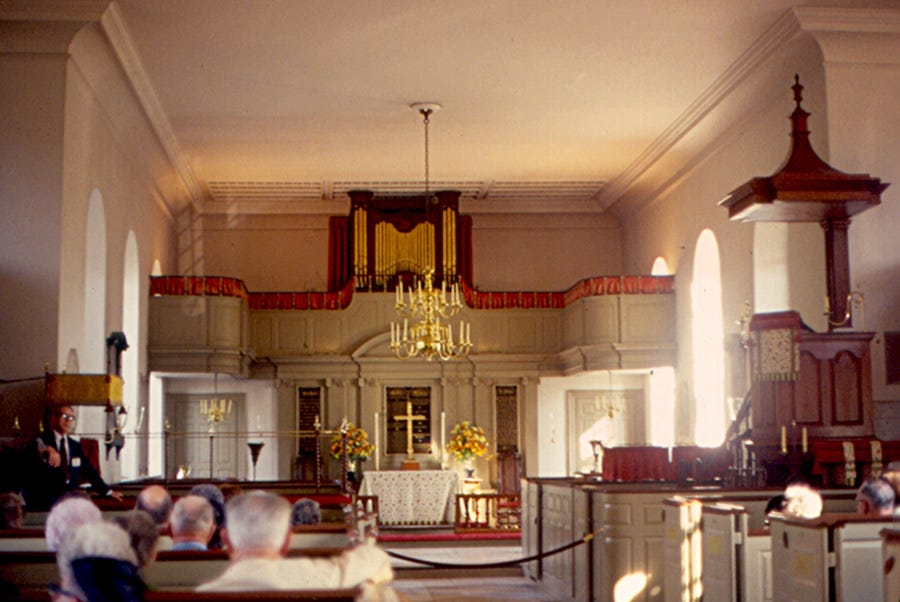
Robert Carter Nicholas also described the service and the sermon:
As to the ordinary service of the church being only performed on the occasion; the late House of Burgesses . . . did not presume to desire that additions should be made to that sacred office, which they knew was properly adapted to every purpose. They did not wish that any thing particularly pointed or inflammatory should fall from the pulpit. A general display of the superintendence of Providence, and the influence, which a thorough conviction and remembrance of this, ought to have, together with an implicit reliance on his goodness were the doctrines which they desired to have inculcated leaving the consideration to their own reflections in making proper applications.[17]
Not only were services held at Bruton Parish Church, but services were held across Virginia:
Most of the ministers participated in the fast day called by the Assembly. In 1774 James Marye, Jr., preached at one service in Fredericksburg while Francis Wilson read the prayers. Isaac Giberne chided his most influential parishioner for not attending his fast day service, and neighbor William McKay preached on the text “be strong & quit yourselves like men” at a “court of liberty” which met in North Farnham Parish to indict Lord North. At Thomas Jefferson’s suggestion, Charles Clay set the fast day in his parish to coincide with the election of Burgesses.[18]
Following the fast day, the Virginia Gazette added a note for the edification of their readers, using the narrative of Abraham’s intercession for Lot and the city of Sodom as an example for how Virginians might pray for Boston. These devotional notes in the Gazette reveal a sharp contrast between expressions of faith in journalism of that period compared to where we are today:
The following text being so extremely applicable, we are requested to insert it. Genesis 18:32, “And he (Abraham) said, Oh, let not the Lord be angry, and I will speak yet but this once; peradventure ten (righteous) shall be found there. And HE said, “I will not destroy it for ten’s sake.” –– Reader, revisit this whole chapter: behold! and adore the goodness and mercy of God.[19]
It is worth noting that histories of this event routinely misread this passage in the Virginia Gazette and misidentify Genesis 18:32 as the text of Price’s sermon, whereas it is clear he preached from Psalm 103:19.
You can observe in the text of Clementina Rind’s June 2, 1774 edition of the Virginia Gazette as shown in the images below that the text Thomas Price preached was indeed Psalm 103:19, and that Genesis 18 was not the sermon text, but a reading recommendation.
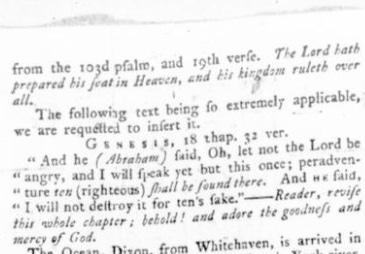
The Colonial Williamsburg Foundation’s article “A Revolutionary Day of Fasting, Humiliation, and Prayer” reported the wrong sermon text, and also misses the detail that Gwatkin wrote the sermon for Price. This error is repeated on another Williamsburg Foundation page about June 1, 1774. This error then ripples through other articles on this event, including Cardinal News and the Hilton Head Island Packet. Obscure and granular details frequently serve to humble historians. This example shows the fallibility of those who write history, and I am confident that I am ignorant of the points where my own writing needs to be straightened.
John Randolph’s Critique and Robert Carter Nicholas’ Defense of the Day
Though the day of prayer and fasting was largely attended and appreciated, opposition and critique persisted on the periphery. John Randolph, Virginia’s Attorney General, opposed the day, which put him at odds with his brother Peyton, the former Speaker of the House.
In a pamphlet entitled “Considerations on the Present State of Virginia,” John Randolph mocked the day of prayer and fasting as simply a delay of “sumptuous suppers” until nighttime. Robert Carter Nicholas responded promptly in another pamphlet, defending the sincerity of the fast day and the spiritual nature of self-examination and repentance which is an essential part of fast days:
I have too much reason to believe that the design of this fast was either misunderstood or misrepresented from the first, having been informed that it was spoke of by some as a scheme calculated to inflame and excite an enthusiastic zeal in the minds of the people, under a cloak of religion; that which nothing could be more calumnious and unjust. The author must know that the resolution was not smuggled, but proposed in a very full House, not above one dissentient appearing amongst near an hundred members. He, himself, I believe was present, and should be glad to know whether he opened his mouth against the measure? Surely he could not want that resolution, he so earnestly recommends, to have avowed his disapprobation. The mixing of religion with civil matters, merely to inflame people’s minds, I know has been practiced on some occasions, but I have ever considered it not only as culpable, but extremely wicked.
It gave me pain to find that the resolution of the House was considered as reflecting upon our gracious Sovereign. Nothing, I hope and believe, was farther from the intention of those, who voted for the Fast, than this. I speak positively for myself.[20]
A High View of King and Country
At this point in 1774 continued loyalty to King George III is observed in many of those who would later support the Revolution. Instead of desiring independence, it was believed that King George would right the wrongs of Parliament, and we see this quite plainly in Nicholas’ rebuttal to John Randolph.
This attitude is similar to what was observed eight years earlier in responses to the Stamp Act. In one example, Thomas Davis preached at his church in Norfolk as they celebrated the repeal of the Stamp Act in 1766, and he condemned the king’s counselors and praised the king from Proverbs: “Take away the dross from the silver, and there shall come forth a vessel for the finer. Take away the wicked from before the King, and his throne shall be established in righteousness.”[21]
Nicholas’ continued loyalty to the British crown is visible in his response to Randolph, as he indeed prayed for reconciliation between Britain and America.
It is . . . my most ardent prayer that all those unhappy differences, which subsist between Great Britain and America may speedily subside and be buried in eternal oblivion; that a perfect reconciliation, and inviolable friendship may be established on the most permanent foundations, and that both countries may still enjoy the inexhaustible sweets of constitutional freedom and liberty till time shall be no more.[22]
The posture of these men at this point was not that of revolutionaries who were seeking independence from Britain. Instead of taking drastic measures, we see a colony interceding for Massachusetts, and choosing to take economic measures to seek redress of grievances and protect British America’s civil liberties.
The following year, as the crisis turned into armed conflict, it is noteworthy to observe that prayer for reconciliation was included in a prayerbook for the American soldier:
And grant, O Lord, that the inhabitants of Great Britain may arise and vindicate their liberties; and a glorious reunion take place between them and thy people in this land, founded upon the principles of liberty and righteousness: that the Britons and the Americans may rejoice in the King as the minister of God to both for good.[23]
This prayer is not for reconciliation alone, but it is also a prayer that the king would fulfill his biblical responsibility to wield the sword as God’s servant for the good of the nation as set forth by the apostle Paul in Romans 13.
Remembering the Past and Considering the Present
As we review the narrative of these events in 1774, there are similarities with the present. Higher education tends toward theological liberalism and frequently scorns the fundamental tenets of the faith. On the other hand, we observe significant discontinuity. It is difficult to imagine that a local newspaper would report on a sermon and add Bible reading recommendations for its readers, or that a whole town would attend a worship service. It has become unthinkable that a prayer book like Abiel Leonard’s would be printed and provided to our armed forces. Our polarized federal and state legislatures appear incapable of being united in anything, let alone in valuing the importance of prayer for our country. In contrast to the dozen pastors who engaged publicly with the events of the day and signed the Virginia Association in Raleigh Tavern, it is far too common for pastors to cloister themselves from public life and submit to anti-Christian dictums that faith only be exercised privately within the home and the church.
As the Virginia Gazette exhorted its readers in 1774, so too may it exhort us in 2026: “Reader, revisit this whole chapter [Genesis 18]: behold! and adore the goodness and mercy of God.”[24] God is truly good and merciful to sinners, and he is worthy of our praise. Though times have and will continue to change, God’s goodness and mercy remain our immutable hope. God is perfect in his righteousness and judgments, and yet he graciously gives mercy to sinners. With this in view, let us be encouraged to earnestly pray for our nation as Abraham interceded for Lot. Let us likewise remember God’s sovereign providence. Our God is not powerless to answer prayer, but he reigns in heaven and governs His universal dominion for the good of his people and his glory. “The LORD has established his throne in the heavens, and his kingdom rules over all” (Psalm 103:19).
[1] Purdie and Dixon’s Virginia Gazette (Williamsburg), May 27, 1774.
[2] Ibid.
[3]Joan R. Gundersen, The Anglican Ministry in Virginia, 1723–1766: A Study of a Social Class (New York: Garland, 1989), 149–50.
[4] Devereux Jarratt, A Brief Narrative of the Revival of Religion in Virginia. In a Letter to a Friend (London: R. Hawes, 1778).
[5] Devereux Jarratt, The Life of the Reverend Devereux Jarratt (1806), 89–90.
[6] Jarratt, Life, 131.
[7] Purdie and Dixon’s Virginia Gazette (Williamsburg), May 27, 1774.
[8]Donald Jackson and Dorothy Twohig, eds., The Diaries of George Washington, vol. 3, 1771–75 (Charlottesville: University Press of Virginia, 1978), entry for May 27, 1774.
[9] House of Burgesses, resolution summoning a convention, May 30, 1774; manuscript held at the Library of Virginia, Richmond.
[10] George Washington to George William Fairfax, June 10, 1774, Founders Online, National Archives.
[11] “Proceedings of a Meeting of the Inhabitants of Dumfries, May 31, 1774,” in Calendar of Virginia State Papers and Other Manuscripts, vol. 8, ed. H. W. Flournoy (Richmond, 1890), 53–54.
[12] Jackson and Twohig, Diaries of George Washington, 3, entry for June 1, 1774.
[13]Purdie and Dixon’s Virginia Gazette (Williamsburg), June 2, 1774.
[14] Dunmore to Dartmouth, June 6, 1774, in The Parliamentary History of England, vol. 18 (London, 1813), 137–38.
[15] Pinkney’s Virginia Gazette (Williamsburg), June 15, 1774.
[16] Rind’s Virginia Gazette (Williamsburg), June 2, 1774.
[17] Robert Carter Nicholas, Considerations on the Present State of Virginia Examined ([Williamsburg: Purdie and Dixon], 1774).
[18]Gundersen, Anglican Ministry in Virginia, 150.
[19]Rind’s Virginia Gazette (Williamsburg), June 2, 1774.
[20] Nicholas, Considerations Examined ([Williamsburg: Purdie and Dixon], 1774).
[21]Gundersen, Anglican Ministry in Virginia, 149.
[22] Nicholas, Considerations Examined ([Williamsburg: Purdie and Dixon], 1774).
[23]Abiel Leonard, A Prayer Composed for the Benefit of the Soldiery, in the American Army (Cambridge, MA, 1775).
[24] Rind’s Virginia Gazette (Williamsburg), June 2, 1774).